How does P2P IP camera work? | Technology News


HOW DOES P2P IP CAMERA WORK?Just input the Device ID and password, without network configuration, your IP camera can connect to network for remotely monitoring. How does it work? The simple answer is “Peer to Peer” or P2P technology. P2P technology can allow camera communicates with other network devices without complicated network settings. Today, we are going to discuss it in this article.

Source: How does P2P IP camera work? | Technology News

Building a low cost wifi camera – Johan Kanflo

Sometime ago I came across the Arducam Mini which is quite a nice camera module from UCTronics. It is a small PCB with a two megapixel OmniVision OV2640 sensor, an interchangeable lens and an FPGA to do the heavy lifting of image processing and JPEG encoding. Priced at around 24 Euros (lens included) you can easily buy a few without hurting your wallet and combined with an ESP8266 you can build quite a low cost wifi camera. Or several. Because designing and building PCBs is both fun and inexpensive I designed a board to go with the ESP8266/Arducam Mini combo, aptly named the Esparducam. And uniquely named too, try googeling for “esparducam“. Heck, even the domain name is available at the time of writing ?

Source: Building a low cost wifi camera – Johan Kanflo

ESP8266 WIFI Camera | Arduino Based Camera

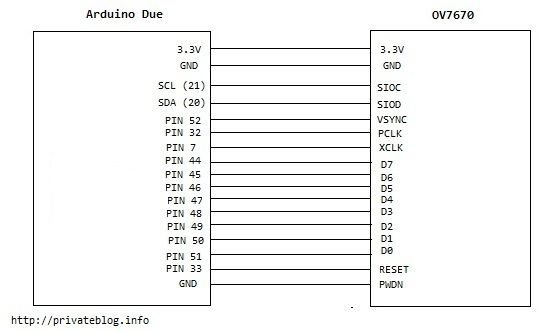
ArduCAM now released a world smallest low cost ESP8266 WIFI IoT camera kit based on ArduCAM-Mini-2MP-V2 and ArduCAM-ESP8266-Nano module. User can implement a 2MP WIFI camera using HTTP or Websocket protocol on ESP8266, and the camera can be acted as an AP and mobile phone/PC can connect to the camera directly or acted as a Station which connected to the home router. The kit can capture 2MP full resolution JPEG still image, even stream low resolution at fairly frame rate video over network or directly save to local SD/TF card. The kit is suitable for portable application, it can be powered from micro-USB or using battery and has build in lithium battery charging circuits. The kit can also be used separately, it is almost identical to standard alone ArduCAM-Mini-2MP camera and ESP8266-12F module. Continue reading “World Smallest ESP8266 WIFI Camera” »

Source: ESP8266 WIFI Camera | Arduino Based Camera

Augmented third

In classical music from Western culture, an augmented third (About this sound Play ) is an interval of fivesemitones. It may be produced by widening a major third by a chromatic semitone.[1][3] For instance, the interval from C to E is a major third, four semitones wide, and both the intervals from C to E, and from C to E are augmented thirds, spanning five semitones. Being augmented, it is considered a dissonant interval.
https://en.m.wikipedia.org/wiki/Augmented_third

Major third

In classical music from Western culture, a third is a musical interval encompassing three staff positions (see Interval number for more details), and the major third (About this sound Play ) is a third spanning four semitones. Along with the minor third, the major third is one of two commonly occurring thirds. It is qualified as major because it is the larger of the two: the major third spans four semitones, the minor third three. For example, the interval from C to E is a major third, as the note E lies four semitones above C, and there are three staff positions from C to E. Diminished andaugmented thirds span the same number of staff positions, but consist of a different number of semitones (two and five).
https://en.m.wikipedia.org/wiki/Major_third

Minor third

In the music theory of Western culture, a minor third is a musical interval that encompasses three half steps, or semitonesStaff notation represents the minor third as encompassing threestaff positions (see: interval number). The minor third is one of two commonly occurring thirds. It is called minor because it is the smaller of the two: the major third spans an additional semitone. For example, the interval from A to C is a minor third, as the note C lies three semitones above A, and (coincidentally) there are three staff positions from A to C. Diminished and augmented thirdsspan the same number of staff positions, but consist of a different number of semitones (two and five). The minor third is a skip melodically.
https://en.m.wikipedia.org/wiki/Minor_third

Major and minor

In Western music, the adjectives major and minor can describe a musical composition,movementsectionscalekeychord, or interval.

Major and minor are frequently referred to in the titles of classical compositions, especially in reference to the key of a piece.

Contents

Intervals and chordsEdit
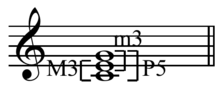
Major and minor third in a major chord: major third ‘M’ on bottom, minor third ‘m’ on top. About this sound Play 

Relative tonic chords on C and A. About this sound Play 

Parallel tonic chords on C

Major chord drawn in the chromatic circle
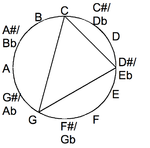
Major chord

Minor chord drawn in the chromatic circle

Minor chord

The difference between the major and minor chord may be seen if they are drawn in chromatic circle.

With regard to intervals, the words major and minor just mean large and small, so a major third is a wider interval, and a minor third a relatively narrow one. The intervals of the second, third, sixth, and seventh (and compound intervals based on them) may be major or minor.

The other uses of major and minor, in general, refer to musical structures containing major thirds or minor thirds. A major scale is one whose third degree is a major third above thetonic, while a minor scale has a minor third degree. A major chord or major triad, similarly, contains a major third above theroot, whereas a minor chord or minor triad contains a minor third above the root. In Western music, a minor chord, in comparison, “sounds darker than a major 

https://en.m.wikipedia.org/wiki/Major_and_minor

Diatonic scale

The major scale or Ionian scale is one of the most commonly used musical scales, especially in Western music. It is one of the diatonic scales. Like many musical scales it is made up of seven notes: the eighth duplicates the first at double itsfrequency so that it is called a higher octave of the same note (from Latin “octavus”, the eighth).

The simplest major scale to write is C major, the only major scale to not require sharps or flats:

C-D-E-F-G-A-B-C (About this sound C major scale )

The major scale had a central importance in European music, particularly in the common practice period and in popular music, owing to the large number of chords that can be formed from it.[citation needed] In Carnatic music, it is known as Dheerasankarabharanam, and in Hindustani classical music it is known as Bilaval.

https://en.m.wikipedia.org/wiki/Diatonic_scale

Major scale

The major scale or Ionian scale is one of the most commonly used musical scales, especially in Western music. It is one of the diatonic scales. Like many musical scales it is made up of seven notes: the eighth duplicates the first at double itsfrequency so that it is called a higher octave of the same note (from Latin “octavus”, the eighth).

The simplest major scale to write is C major, the only major scale to not require sharps or flats:

C-D-E-F-G-A-B-C (About this sound C major scale )

The major scale had a central importance in European music, particularly in the common practice period and in popular music, owing to the large number of chords that can be formed from it.[citation needed] In Carnatic music, it is known as Dheerasankarabharanam, and in Hindustani classical music it is known as Bilaval.

https://en.m.wikipedia.org/wiki/Major_scale

F-sharp major

F major or F-sharp major is a major scale based on F, consisting of the pitches FG,ABCD, and E. Its key signature has six sharps.[1]

F major
F-sharp-major d-sharp-minor.svg
Relative key D minor
Parallel key F minor
Dominant key C major
Subdominant B major
Enharmonic G major
Component pitches
F, G, A, B, C, D, E, F

Its relative minor is D minor (or enharmonically E minor). Its parallel minor isF minor. Its enharmonic equivalent is Gmajor. In writing music for transposing instruments in B-flat or E-flat, it is preferable to use a G-flat rather than an F-sharp key signature. If F-sharp major must absolutely be used, one should take care that B-flat wind instruments be notated in A-flat major, rather than G-sharp major (or G instruments used instead, giving a transposed key of B major), and D-flat instruments in F major instead of E-sharp major, in order to avoid double sharps in key signatures.

https://en.m.wikipedia.org/wiki/F-sharp_major