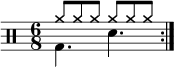
Source: Additive meter – Definition (Artopium’s Music Dictionary)
Yo-Yo Ma: Tchaikovsky “Andante Cantabile” (live) – YouTube
Linear network coding – Wikipedia
Network coding is a field of research founded in a series of papers from the late 1990s to the early 2000s. However, the concept of network coding, in particular linear network coding, appeared much earlier. In a 1978 paper, a scheme for improving the throughput of a two-way communication through a satellite was proposed. In this scheme, two users trying to communicate with each other transmit their data streams to a satellite, which combines the two streams by summing them modulo 2 and then broadcasts the combined stream. Each of the two users, upon receiving the broadcast stream, can decode the other stream by using the information of their own stream.
The 2000 paper gave the butterfly network example (discussed below) that illustrates how linear network coding can outperform routing. This example is equivalent to the scheme for satellite communication described above. The same paper gave an optimal coding scheme for a network with one source node and three destination nodes. This is the first example illustrating the optimality of convolutional network coding (a more general form of linear network coding) over a cyclic network.
Linear network coding may be used to improve a network’s throughput, efficiency and scalability, as well as resilience to attacks and eavesdropping. Instead of simply relaying the packets of information they receive, the nodes of a network take several packets and combine them together for transmission. This may be used to attain the maximum possible information flow in a network.
It has been mathematically proven in theory that linear coding is enough to achieve the upper bound in multicast problems with one source. However linear coding is not sufficient in general (e.g. multisource, multisink with arbitrary demands), even for more general versions of linearity such as convolutional coding and filter-bank coding.[4] Finding optimal coding solutions for general network problems with arbitrary demands remains an open problem.
Mode (music)
Mode Tonic relative
to major scaleInterval sequence Example Ionian I W-W-H-W-W-W-H C-D-E-F-G-A-B-C Dorian II W-H-W-W-W-H-W D-E-F-G-A-B-C-D Phrygian III H-W-W-W-H-W-W E-F-G-A-B-C-D-E Lydian IV W-W-W-H-W-W-H F-G-A-B-C-D-E-F Mixolydian V W-W-H-W-W-H-W G-A-B-C-D-E-F-G Aeolian VI W-H-W-W-H-W-W A-B-C-D-E-F-G-A Locrian VII H-W-W-H-W-W-W B-C-D-E-F-G-A-B
![]()
Source: Mode (music) – Wikipedia
Bésame Mucho, Español-English
Bésame Mucho
Letra y Música de Consuelo Velázquez (1940)
4/4
(introducción instrumental de 9 medidas)
Bésame,
bésame mucho —
como si fuera esta noche
la ultima vez.
Bésame,
bésame mucho —
que tengo miedo a per-derte,
perderte después. —
(repite, y entonces la música cambia un poquito) …-derte, perderte después. —
Quiero tenerte muy cerca
mirar me en tus ojos
verte junto a mi.
Piensa que tal vez mañana
yo ya estaré lejos
muy lejos de ti.
Bésame,
bésame mucho —
como si fuera esta noche
la ultima vez.
Bésame,
bésame mucho —
que tengo miedo a perderte,
perderte des-pués. —
(“-pués” tiene 3 tiempos, se sigue con un tiempo y entonces 7 medidas de música)
Bésame,
bésame mucho —
que tengo miedo a perderte,
perderte después. —
Que tengo miedo a perderte, —
perderte des-pués. — — —
(el ultimo “-pués” tiene 5 y 3/4 medidas, un instrumental sigue con 7 y 1/4)
<><><><><><><><><>
Bésame Mucho (a translation)
Words and Music by Consuelo Velázquez (1940)
4/4
(instrumental introduction of 9 measures)
Kiss me now,
kiss me with passion —
kiss me as if this were to be
our very last night.
Kiss me now,
kiss me with passion —
for you I may never-more see
once past early light.
(repeat, then the music changes a little bit) …-more see once past early light. —
I want to hold you so closely,
look into your eyes to find
you mirroring me.
I’m sure dawn will find me lonely
cast away so far behind
where you then will be.
Kiss me now,
kiss me with passion —
kiss me as if this were to be
our very last night.
Kiss me now,
kiss me with passion —
for you I may nevermore see
once past early light.
(“light” has three beats followed by one beat then 7 measures of music)
Kiss me now
kiss me with passion —
fearing tomorrow I’ll lose you
past dawn’s early light; —
and I may forever lose you, —
forever lose you. — — —
(the last “you” has 5 and 3/4 measures, followed by 7 and 1/4 measures of music)
<><><><><><><><><>
https://manuelgarciajr.com/2013/12/24/besame-mucho-espanol-english/
E minor
E minor is a minor scale based on E, consisting of the pitches E, F♯, G, A, B, C, and D. Its key signature has one sharp. Its relative major is G major and its parallel major is E major.
The E natural minor scale is:
Source: E minor – Wikipedia
Anne Sophie-Mutter – Mendelssohn Violin Concerto in E minor, Op.64 – Kurt Masur – YouTube
Can You Ever Forgive Me? (2018) – IMDb
Clémentine Margaine
A minor
Source: A minor – Wikipedia