Science and math

Prime number theorem

In mathematics, the prime number theorem (PNT) describes the asymptotic distribution of the prime numbers among the positive integers. It formalizes the intuitive idea that primes become less common as they become larger by precisely quantifying the rate at which this occurs. The theorem was proved independently by Jacques Hadamard and Charles Jean de la Vallée Poussin in 1896 using ideas introduced by Bernhard Riemann (in particular, the Riemann zeta function).

The first such distribution found is π(N) ~ N/log(N), where π(N) is the prime-counting function (the number of primes less than or equal to N) and log(N) is the natural logarithm of N. This means that for large enough N, the probability that a random integer not greater than N is prime is very close to 1 / log(N). Consequently, a random integer with at most 2n digits (for large enough n) is about half as likely to be prime as a random integer with at most n digits. For example, among the positive integers of at most 1000 digits, about one in 2300 is prime (log(101000) ≈ 2302.6), whereas among positive integers of at most 2000 digits, about one in 4600 is prime (log(102000) ≈ 4605.2). In other words, the average gap between consecutive prime numbers among the first N integers is roughly log(N).

https://en.wikipedia.org/wiki/Prime_number_theorem

Curvilinear coordinates

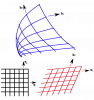
In geometrycurvilinear coordinates are a coordinate system for Euclidean space in which the coordinate lines may be curved. These coordinates may be derived from a set of Cartesian coordinates by using a transformation that is locally invertible (a one-to-one map) at each point. 

https://en.wikipedia.org/wiki/Curvilinear_coordinates#:~:text=In%20geometry%2C%20curvilinear%20coordinates%20are,one%20map)%20at%20each%20point.

Gregorio Ricci-Curbastro

Gregorio Ricci-Curbastro (Italian: [ɡreˈɡɔːrjo ˈrittʃi kurˈbastro]; 12 January 1853 – 6 August 1925) was an Italian mathematician. He is most famous as the discoverer of tensor calculus.

With his former student Tullio Levi-Civita, he wrote his most famous single publication, a pioneering work on the calculus of tensors, signing it as Gregorio Ricci. This appears to be the only time that Ricci-Curbastro used the shortened form of his name in a publication, and continues to cause confusion.

Ricci-Curbastro also published important works in other fields, including a book on higher algebra and infinitesimal analysis,and papers on the theory of real numbers, an area in which he extended the research begun by Richard Dedekind.

https://en.wikipedia.org/wiki/Gregorio_Ricci-Curbastro

Gottlob Frege

Friedrich Ludwig Gottlob Frege (/ˈfreɪɡə/; German: [ˈɡɔtloːp ˈfreːɡə]; 8 November 1848 – 26 July 1925) was a German philosopher, logician, and mathematician. He was a mathematics professor at the University of Jena, and is understood by many to be the father of analytic philosophy, concentrating on the philosophy of language, logic, and mathematics. Though he was largely ignored during his lifetime, Giuseppe Peano (1858–1932), Bertrand Russell (1872–1970), and, to some extent, Ludwig Wittgenstein (1889–1951) introduced his work to later generations of philosophers. Frege is widely considered to be the greatest logician since Aristotle, and one of the most profound philosophers of mathematics ever.

His contributions include the development of modern logic in the Begriffsschrift and work in the foundations of mathematics. His book the Foundations of Arithmetic is the seminal text of the logicist project, and is cited by Michael Dummett as where to pinpoint the linguistic turn. His philosophical papers “On Sense and Reference” and “The Thought” are also widely cited. The former argues for two different types of meaning and descriptivism. In Foundations and “The Thought”, Frege argues for Platonism against psychologism or formalism, concerning numbers and propositions respectively. Russell’s paradox undermined the logicist project by showing Frege’s Basic Law V in the Foundations to be false.

https://en.wikipedia.org/wiki/Gottlob_Frege