Aleksandra Kurzak (born 7 August 1977 in Brzeg Dolny) is a Polish operatic soprano. She has performed on many prominent international stages across Europe and Northern America including Royal Opera House in London, the Metropolitan Opera in New York, Vienna State Opera, and the Paris Opera. She had been successful in light and coloratura soprano roles and gradually taking on heavier roles in Italian Bel Canto and Verismo repertoire.
Music
Joan Sutherland & Luciano Pavarotti; “Da quel di che t’incontrai”; Linda di Chamounix; Donizetti – YouTube
Additive rhythm and divisive rhythm
In music, the terms additive and divisive are used to distinguish two types of both rhythm and meter:
- A divisive (or, alternately, multiplicative) rhythm is a rhythm in which a larger period of time is divided into smaller rhythmic units or, conversely, some integer unit is regularly multiplied into larger, equal units.
- This can be contrasted with additive rhythm, in which larger periods of time are constructed by concatenating (joining end to end) a series of units into larger units of unequal length, such as a 5
8 meter produced by the regular alternation of 2
8 and 3
8 (London 2001, §I.8).
When applied to meters, the terms perfect and imperfect are sometimes used as the equivalents of divisive and additive, respectively (Read 1969, 150).
For example, 4 may be evenly divided by 2 or reached by adding 2 + 2. In contrast, 5 is only evenly divisible by 5 and 1 and may be reached by adding 2 or 3. Thus, 4
8 (or, more commonly, 2
4) is divisive while 5
8 is additive.
Additive meter – Definition
Source: Additive meter – Definition (Artopium’s Music Dictionary)
Yo-Yo Ma: Tchaikovsky “Andante Cantabile” (live) – YouTube
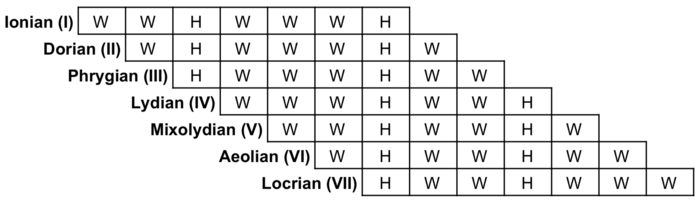
Mode (music)
Mode Tonic relative
to major scaleInterval sequence Example Ionian I W-W-H-W-W-W-H C-D-E-F-G-A-B-C Dorian II W-H-W-W-W-H-W D-E-F-G-A-B-C-D Phrygian III H-W-W-W-H-W-W E-F-G-A-B-C-D-E Lydian IV W-W-W-H-W-W-H F-G-A-B-C-D-E-F Mixolydian V W-W-H-W-W-H-W G-A-B-C-D-E-F-G Aeolian VI W-H-W-W-H-W-W A-B-C-D-E-F-G-A Locrian VII H-W-W-H-W-W-W B-C-D-E-F-G-A-B
![]()
Source: Mode (music) – Wikipedia
E minor
E minor is a minor scale based on E, consisting of the pitches E, F♯, G, A, B, C, and D. Its key signature has one sharp. Its relative major is G major and its parallel major is E major.
The E natural minor scale is:
Source: E minor – Wikipedia
Anne Sophie-Mutter – Mendelssohn Violin Concerto in E minor, Op.64 – Kurt Masur – YouTube
Clémentine Margaine
A minor
Source: A minor – Wikipedia