Ivan Illich – Wikipedia
 Jovan Stosic
Jovan Stosic
Jovan Stosic
Jovan Stosic
Jovan Stosic
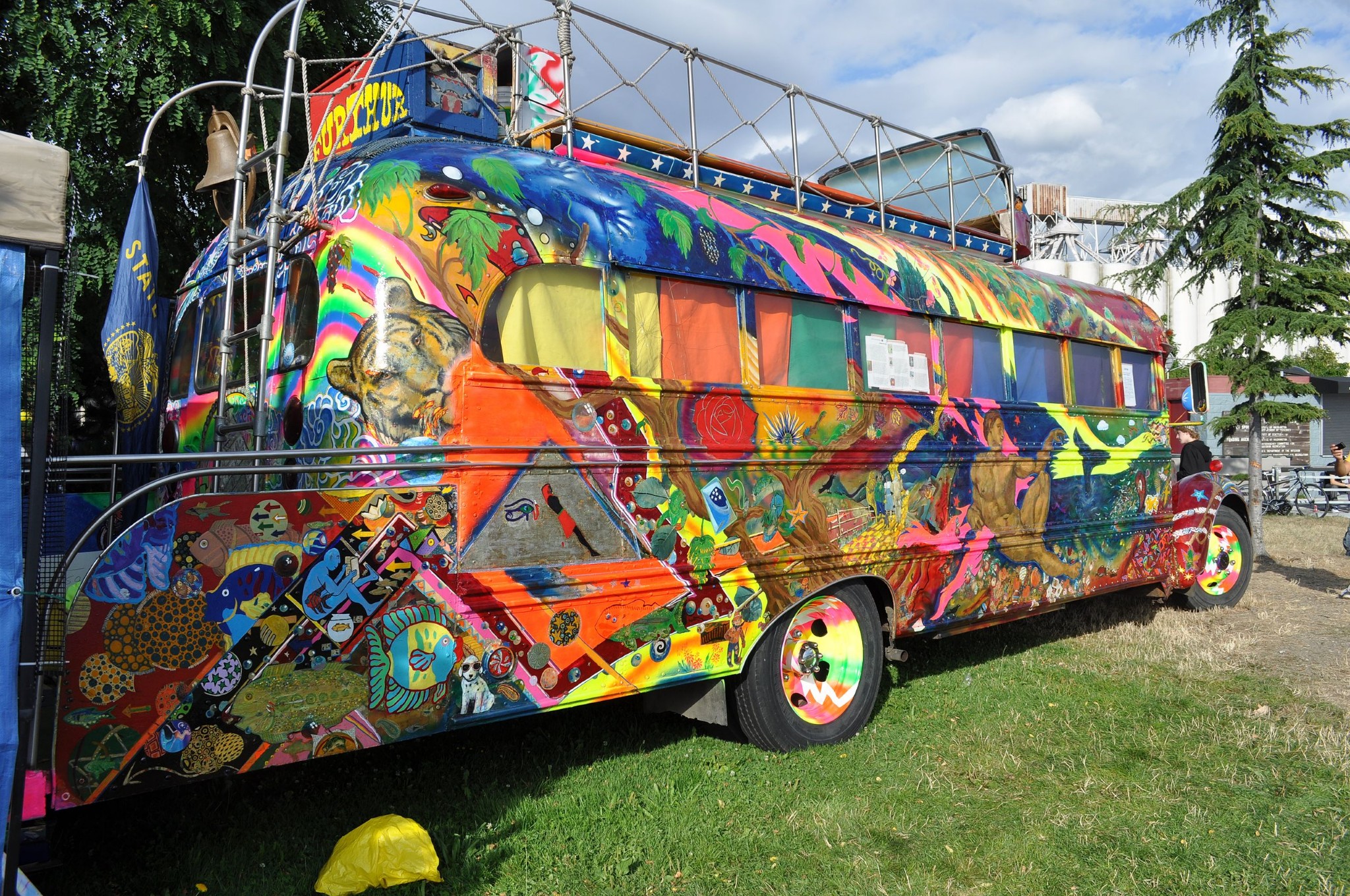
The Merry Pranksters were cohorts and followers of American author Ken Kesey in 1964.
Ken Kesey and the Merry Pranksters lived communally at Kesey’s homes in California and Oregon, and are noted for the sociologicalsignificance of a lengthy road trip they took in the summer of 1964, traveling across the United States in a psychedelic painted school bus called Furthur or Further, organizing parties and giving out LSD. During this time they met many of the guiding lights of the mid-1960scultural movement and presaged what are commonly thought of as hippies with odd behavior, tie-dyed and red, white and blue clothing, and renunciation of normal society, which they dubbed The Establishment. Tom Wolfe chronicled their early escapades in The Electric Kool-Aid Acid Test; Wolfe also documents a notorious 1966 trip on Further from Mexico through Houston, stopping to visit Kesey’s friend, novelistLarry McMurtry. Kesey was in flight from a drug charge at the time.[2] Notable members of the group include Kesey’s best friend Ken Babbs,Carolyn “Mountain Girl” Garcia, Lee Quarnstrom, and Neal Cassady. Stewart Brand, Paul Foster, Dale Kesey (his cousin), George Walker, the Warlocks (now known as the Grateful Dead), Del Close (then a lighting designer for the Grateful Dead), Wavy Gravy, Paul Krassner, and Kentucky Fab Five writers Ed McClanahan and Gurney Norman (who overlapped with Kesey and Babbs as creative writing graduate students at Stanford University) were associated with the group to varying degrees.
These events are also documented by one of the original pranksters, Lee Quarnstrom, in his memoir, When I Was a Dynamiter.
Jovan Stosic
Jovan Stosic
The counterculture of the 1960s refers to an anti-establishment cultural phenomenon that developed first in the United Kingdom (UK) and the United States (US) and then spread throughout much of the Western world between the early 1960s and the mid-1970s, withLondon, New York City, and San Francisco being hotbeds of early countercultural activity. The aggregate movement gained momentum as the Civil Rights Movement continued to grow, and would later become revolutionary with the expansion of the U.S. government’s extensive military intervention in Vietnam. As the 1960s progressed, widespread social tensions also developed concerning other issues, and tended to flow along generational lines regarding human sexuality, women’s rights, traditional modes of authority, experimentation with psychoactive drugs, and differing interpretations of theAmerican Dream. Many key movements related to these issues were born or advanced within the counterculture of the 1960s.
https://en.m.wikipedia.org/wiki/Counterculture_of_the_1960s
Jovan Stosic
Jovan Stosic
Jovan Stosic
Jovan Stosic
Mount Ararat (/ˈærəˌræt/ ARR-ə-rat;[8] Turkish: Ağrı Dağı; Armenian: Մասիս, Masis and Արարատ, Ararat) is a snow-capped and dormant compound volcano in the extreme east of Turkey.[9] It consists of two major volcanic cones: Greater Ararat, the highest peak in Turkey and the Armenian plateau with an elevation of 5,137 m (16,854 ft); and Little Ararat, with an elevation of 3,896 m (12,782 ft).[10] The Ararat massif is about 40 km (25 mi) in diameter.
Despite the scholarly consensus that the “mountains of Ararat” of the Book of Genesis do not refer to specifically Mt. Ararat, it has been widely accepted in Abrahamic religions as the resting place of Noah’s Ark. It is the principal national symbol of Armenia and has been considered a sacred mountain by Armenians. It is featured prominently in Armenian literature and art and is an icon for Armenian irredentism. Along with Noah’s Ark, it is depicted on the coat of arms of Armenia.
The first efforts to reach Ararat’s summit were made in the Middle Ages. However, it was not until 1829 when Friedrich Parrot and Khachatur Abovian, accompanied by four others, made the first recorded ascent
Jovan Stosic
The Night of the Long Knives also called Operation Hummingbird (German: Unternehmen Kolibri) or, in Germany, the Röhm Putsch[a] (German spelling: Röhm-Putsch), was a purge that took place in Nazi Germany from June 30 to July 2, 1934, when the Nazi regime carried out a series of political extrajudicial executions intended to consolidate Hitler’s absolute hold on power in Germany. Many of those killed were leaders of the SA (Sturmabteilung), the Nazis’ own paramilitary Brownshirts organization; the best-known victim was Ernst Röhm, the SA’s leader and one of Hitler’s longtime supporters and allies. Leading members of the left-wing Strasserist faction of the Nazi Party (NSDAP), along with its figurehead, Gregor Strasser, were also killed, as were establishment conservatives and anti-Nazis (such as former Chancellor Kurt von Schleicher and Bavarian politician Gustav Ritter von Kahr, who had suppressed Adolf Hitler‘s Munich Beer Hall Putsch in 1923). The murders of Brownshirt leaders were also intended to improve the image of the Hitler government with a German public that was increasingly critical of thuggish Brownshirt tactics.
https://en.m.wikipedia.org/wiki/Night_of_the_Long_Knives
Jovan Stosic
Jovan Stosic
In classical music from Western culture, an augmented third ( Play ) is an interval of fivesemitones. It may be produced by widening a major third by a chromatic semitone.[1][3] For instance, the interval from C to E is a major third, four semitones wide, and both the intervals from C♭ to E, and from C to E♯ are augmented thirds, spanning five semitones. Being augmented, it is considered a dissonant interval.
https://en.m.wikipedia.org/wiki/Augmented_third
Jovan Stosic
The major scale or Ionian scale is one of the most commonly used musical scales, especially in Western music. It is one of the diatonic scales. Like many musical scales it is made up of seven notes: the eighth duplicates the first at double itsfrequency so that it is called a higher octave of the same note (from Latin “octavus”, the eighth).
The simplest major scale to write is C major, the only major scale to not require sharps or flats:
C major scale )The major scale had a central importance in European music, particularly in the common practice period and in popular music, owing to the large number of chords that can be formed from it.[citation needed] In Carnatic music, it is known as Dheerasankarabharanam, and in Hindustani classical music it is known as Bilaval.

.jpg)

