How Renaissance’s Medallion Fund Became Finance’s Blackest Box – Bloomberg
 Jovan Stosic
Jovan Stosic
Jovan Stosic
Jovan Stosic
Jovan Stosic
Jovan Stosic
Jovan Stosic
Jovan Stosic
Jovan Stosic
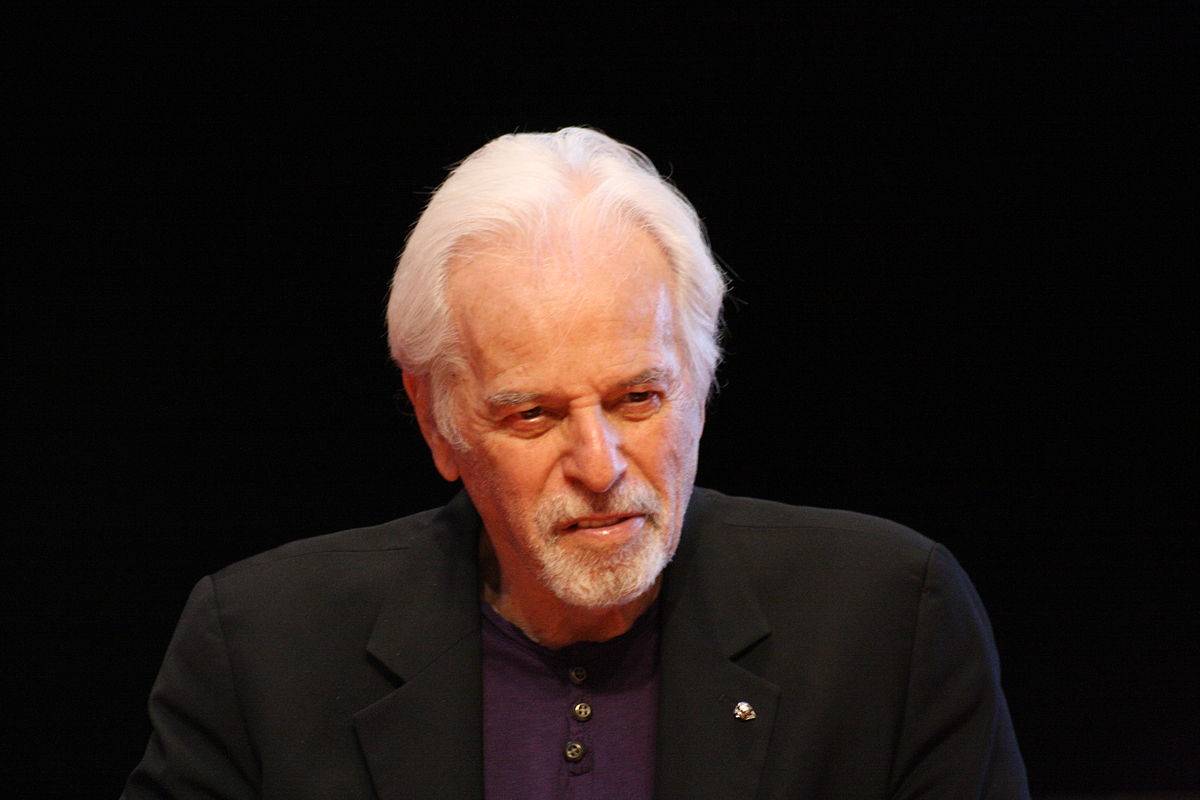
Alejandro Jodorowsky Prullansky (Spanish: [aleˈxandɾo xoðoˈɾofski]; born 17 February 1929)[1][2][3]is a Chilean[4][5]-French film and theatre director, screenwriter, playwright, actor, author, poet, producer, composer, musician, comics writer, and spiritual guru. Best known for his avant-garde films, he has been “venerated by cult cinema enthusiasts” for his work which “is filled with violently surrealimages and a hybrid blend of mysticism and religious provocation”.[6]
Born to Jewish-Ukrainian and Polish parents in Chile, Jodorowsky experienced an unhappy and alienated childhood, and so immersed himself in reading and writing poetry. Dropping out of college, he became involved in theater and in particular mime, working as a clown before founding his own theater troupe, the Teatro Mimico, in 1947. Moving to Paris in the early 1950s, Jodorowsky studied mime under Étienne Decroux before turning to cinema, directing the short film Les têtes interverties in 1957. From 1960 he divided his time between Paris and Mexico City, in the former becoming a founding member of the anarchistic avant-garde Panic Movement of performance artists. In 1966 he created his first comic strip, Anibal 5, while in 1967 he directed his first feature film, the surrealistFando y Lis, which caused a huge scandal in Mexico, eventually being banned.
His next film, the acid western El Topo (1970), became a hit on the midnight movie circuit in the United States, considered as the first-ever midnight cult film, garnering high praise from John Lennon, which led to Jodorowsky being provided with $1 million to finance his next film. The result was The Holy Mountain (1973), a surrealist exploration of western esotericism. Disagreements with the film’s distributor Allen Klein, however, led to both The Holy Mountain and El Topo failing to gain widespread distribution, although both became classics on the underground film circuit.[6]
After an aborted attempt at filming Frank Herbert‘s 1965 science fiction novel Dune, Jodorowsky produced three more films, the family film Tusk (1980), the surrealist horror Santa Sangre (1989), and the failed blockbuster The Rainbow Thief (1990). Meanwhile, he has simultaneously written a series of science fiction comic books, most notably The Incal (1980–1989), which has been described as having a claim to be “the best comic book” ever written,[7] and also The Technopriests and Metabarons. Accompanying this, he has also written books and regularly lectures on his own spiritual system, which he calls “psychomagic” and “psychoshamanism” and which borrows from his interests in alchemy, the tarot, Zen Buddhism and shamanism.[8] His son Cristóbal has followed his teachings on psychoshamanism; this work is captured in the feature documentary Quantum Men, directed by Carlos Serrano Azcona.
Source: Alejandro Jodorowsky – Wikipedia
Jovan Stosic
As-salāmu ʿalaykum (Arabic: السَّلَامُ عَلَيْكُمْ [asːaˈlaːmu ʕaˈlaikum]) is a greeting in Arabic that means “peace be upon you”. The greeting is a standard salutation among Muslims and is routinely used whenever and wherever Muslims gather and interact, whether socially or within worship and other contexts. [1] The typical response to the greeting is waʿalaykumu s-salām (وَعَلَيْكُم السَّلَام [waʕaˈlaikumu sːaˈlaːm]; “and upon you, peace”).
This greeting appears in greatly abbreviated forms in many languages from Malagasy to Urdu as some variant of salām (سَلَام; cf. Persian سلام [sæˈlɒːm]).
Source: As-salamu alaykum – Wikipedia
Jovan Stosic
Jovan Stosic
Jovan Stosic
Pound for pound the B’Twin Ultra 700 AF leaves the competition standing
Jovan Stosic
https://en.m.wikipedia.org/wiki/Go_(game)
Go (traditional Chinese: 圍棋; simplified Chinese: 围棋; pinyin:  wéiqí; Japanese: 囲碁;rōmaji: igo[nb 2]; Korean: 바둑; romaja: baduk[nb 3]; literally: “encircling game”) is an abstract strategy board game for two players, in which the aim is to surround more territory than the opponent.
Jovan Stosic
https://en.m.wikipedia.org/wiki/Anuta
Anuta is a small high island in the southeastern part of the Solomon Islands province of Temotu, one of the smallest permanently inhabited Polynesian islands.[1] It is one of the Polynesian Outlier communities in Melanesia.
Jovan Stosic
À la carte /ɑːləˈkɑːrt/[1] is an English language loan phrase meaning “according to the menu.”[2][3] It was adopted from French in the early 19th Century and refers to “food that can be ordered as separate items, rather than part of a set meal.”[4] The phrase is used in reference to a menu of items priced and ordered separately, i.e., the usual operation of restaurants. This is in contrast to a table d’hôte, where a menu has limited or no choice of items and is served at a fixed price.[5] It may also be use
Source: À la carte – Wikipedia
Jovan Stosic
MPEG transport stream (MPEG-TS, MTS or TS) is a standard digital container format for transmission and storage of audio, video, and Program and System Information Protocol (PSIP) data.[3] It is used in broadcast systems such as Digital Video Broadcasting (DVB), ATSC and IPTV. Transport stream specifies a container format encapsulating packetized elementary streams, with error correction and stream synchronization features for maintaining transmission integrity when the signal is degraded. Transport streams