Science and math

James Watson

James Dewey Watson (born April 6, 1928) is an American molecular biologist, geneticistand zoologist, best known as one of the co-discoverers of the structure of DNA in 1953 with Francis Crick. Watson, Crick, and Maurice Wilkins were awarded the 1962 Nobel Prize in Physiology or Medicine “for their discoveries concerning the molecular structure of nucleic acids and its significance for information transfer in living material”.

https://en.wikipedia.org/wiki/James_Watson

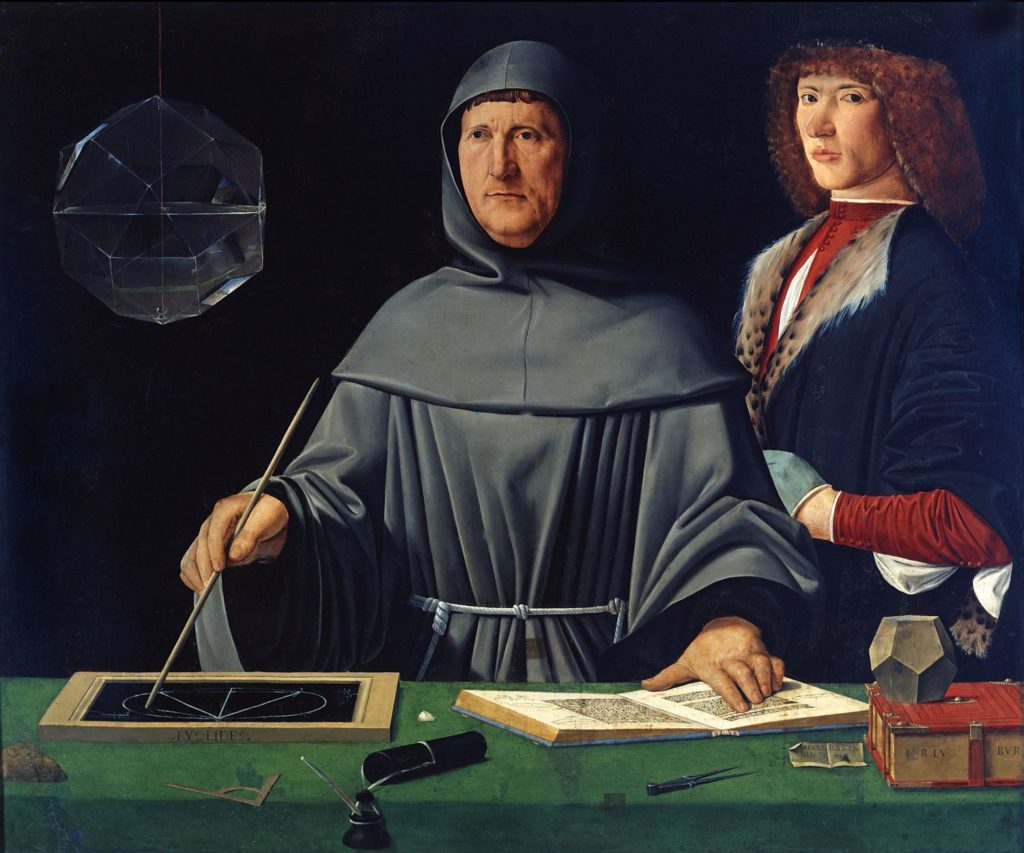
Luca Pacioli

Fra Luca Bartolomeo de Pacioli (sometimes Paccioli or Paciolo; c. 1447 – 19 June 1517) was an Italian mathematician, Franciscan friar, collaborator with Leonardo da Vinci, and an early contributor to the field now known as accounting. He is referred to as “The Father of Accounting and Bookkeeping” in Europe and he was the first person to publish a work on the double-entry system of book-keeping on the continent.[4] He was also called Luca di Borgo after his birthplace, Borgo Sansepolcro, Tuscany.

Source: Luca Pacioli – Wikipedia

George Boole

George Boole (/bl/; 2 November 1815 – 8 December 1864) was an English mathematician, educator, philosopher and logician. He worked in the fields of differential equations and algebraic logic, and is best known as the author of The Laws of Thought (1854) which contains Boolean algebra. Boolean logic is credited with laying the foundations for the information age.[3] Boole maintained that:

George Boole
George Boole color.jpg

Boole, c. 1860

Born 2 November 1815
LincolnLincolnshire, England
Died 8 December 1864(aged 49)
BallintempleCork, Ireland
Education Bainbridge’s Commercial Academy[1]
Era 19th-century philosophy
Region Western philosophy
School Mathematical foundations of computing
Institutions Lincoln Mechanics’ Institute[2]
Queen’s College, Cork

Main interests

Mathematics, LogicPhilosophy of mathematics

Notable ideas

Boolean algebra

No general method for the solution of questions in the theory of probabilities can be established which does not explicitly recognise, not only the special numerical bases of the science, but also those universal laws of thought which are the basis of all reasoning, and which, whatever they may be as to their essence, are at least mathematical as to their form.[4]

https://en.wikipedia.org/wiki/George_Boole