Music

Enharmonic

In modern musical notation and tuning, an enharmonic equivalent is a note, interval, or key signature that is equivalent to some other note, interval, or key signature but “spelled”, or named differently. Thus, the enharmonic spelling of a written note, interval, or chord is an alternative way to write that note, interval, or chord. For example, in twelve-tone equal temperament (the currently predominant system of musical tuning in Western music), the notes C♯ and D♭ are enharmonic (or enharmonically equivalent) notes. Namely, they are the same key on a keyboard, and thus they are identical in pitch, although they have different names and different roles in harmony and chord progressions.

Source: Enharmonic – Wikipedia

Root (chord)

In music theory, the concept of root is the idea that a chord can be represented and named by one of its notes. It is linked to harmonic thinking—to the idea that vertical aggregates of notes can form a single unit, a chord. It is in this sense that one speaks of a “C chord” or a “chord on C”—a chord built from “C” and of which the note (or pitch) “C” is the root. When a chord is referred to in Classical music or popular music without a reference to what type of chord it is (either major or minor, in most cases), it is assumed a major triad, which for C contains the notes C, E and G. The root needs not be the bass note, the lowest note of the chord: the concept of root is linked to that of the inversion of chords, which is derived from the notion of invertible counterpoint. In this concept, chords can be inverted while still retaining their root.
In tertian harmonic theory, that is in a theory where chords can be considered stacks of third intervals (e.g. in common practice tonality), the root of a chord is the note on which the subsequent thirds are stacked. For instance, the root of a triad such as C Major is C, independently of the vertical order in which the three notes (C, E and G) are presented. A triad can be in three possible positions, a “root position” with the root in the bass (i.e., with the root as the lowest note, thus C, E, G or C, G, E, from lowest to highest notes), a first inversion, e.g. E, C, G or E, G, C (i.e., with the note which is a third interval above the root, E, as the lowest note) and a second inversion, e.g. G, C, E or G, E, C, in which the note that is a fifth interval above the root (G ) is the lowest note.
Regardless of whether a chord is in root position or in an inversion, the root remains the same in all three cases. Four-note seventh chords have four possible positions. That is, the chord can be played with the root as the bass note, the note a third above the root as the bass note (first inversion), the note a fifth above the root as the bass note (second inversion), or the note a seventh above the root as the bass note (third inversion). Five-note ninth chords know five positions, etc., but the root position always is that of the stack of thirds, and the root is the lowest note of this stack (see also Factor (chord)).

Source: Root (chord) – Wikipedia

Celesta

The celesta /sᵻˈlɛstə/ or celeste /sᵻˈlɛst/ is a struck idiophone operated by a keyboard. It looks similar to an upright piano (four- or five-octave), albeit with smaller keys and a much smaller sized cabinet, or a large wooden music box (three-octave). The keys connect to hammers that strike a graduated set of metal (usually steel) plates or bars suspended over wooden resonators. Four- or five-octave models usually have a damper pedal that sustains or damps the sound. The three-octave instruments do not have a pedal because of their small “table-top” design. One of the best-known works that uses the celesta is Tchaikovsky’s “Dance of the Sugar Plum Fairy” from The Nutcracker.
The sound of the celesta is similar to that of the glockenspiel, but with a much softer and more subtle timbre. This quality gave the instrument its name, celeste meaning “heavenly” in French. The celesta is often used to enhance a melody line played by another instrument or section. The delicate, bell-like sound is not loud enough to be used in full ensemble sections; as well, the celesta is rarely given standalone solos.
The celesta is a transposing instrument; it sounds one octave higher than the written pitch. Its (four-octave) sounding range is generally considered to be C4 to C8. The original French instrument had a five-octave range, but because the lowest octave was considered somewhat unsatisfactory, it was omitted from later models. The standard French four-octave instrument is now gradually being replaced in symphony orchestras by a larger, five-octave German model. Although it is a member of the percussion family, in orchestral terms it is more properly considered a member of the keyboard section and usually played by a keyboardist. The celesta part is normally written on two braced staves, called a grand staff.

Source: Celesta – Wikipedia

Glockenspiel

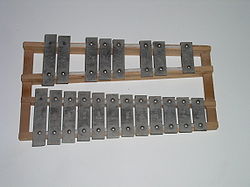
Glockenspiel.jpg

A glockenspiel (German pronunciation: [ˈɡlɔkənˌʃpiːl] or [ˈɡlɔkŋ̍ˌʃpiːl], Glocken: bells and Spiel: set) is a percussion instrument composed of a set of tuned keys arranged in the fashion of the keyboard of a piano. In this way, it is similar to the xylophone; however, the xylophone’s bars are made of wood, while the glockenspiel’s are metal plates or tubes, thus making it a metallophone. The glockenspiel, moreover, is usually smaller and higher in pitch.
In German, a carillon is also called a Glockenspiel, while in French, the glockenspiel is often called a carillon. In music scores the glockenspiel is sometimes designated by the Italian term campanelli.

Source: Glockenspiel – Wikipedia

Carl Maria von Weber

Carl Maria Friedrich Ernst von Weber (18 or 19 November 1786 – 5 June 1826) was a German composer, conductor, pianist, guitarist and critic, one of the first significant composers of the Romantic school.
Weber’s operas Der Freischütz, Euryanthe and Oberon greatly influenced the development of the Romantische Oper (Romantic opera) in Germany. Der Freischütz came to be regarded as the first German “nationalist” opera, Euryanthe developed the Leitmotif technique to an unprecedented degree, while Oberon may have influenced Mendelssohn’s music for A Midsummer Night’s Dream and, at the same time, revealed Weber’s lifelong interest in the music of non-Western cultures. This interest was first manifested in Weber’s incidental music for Schiller’s translation of Gozzi’s Turandot, for which he used a Chinese melody, making him the first Western composer to use an Asian tune that was not of the pseudo-Turkish kind popularized by Mozart and others.

Source: Carl Maria von Weber – Wikipedia

Leitmotif

A leitmotif or leitmotiv /ˌlaɪtmoʊˈtiːf/ is a “short, constantly recurring musical phrase” associated with a particular person, place, or idea. It is closely related to the musical concepts of idée fixe or motto-theme. The spelling leitmotif is an anglicisation of the German Leitmotiv (IPA: [ˈlaɪtmoˌtiːf]), literally meaning “leading motif”, or perhaps more accurately, “guiding motif”. A musical motif has been defined as a “short musical idea … melodic, harmonic, or rhythmic, or all three”, a salient recurring figure, musical fragment or succession of notes that has some special importance in or is characteristic of a composition: “the smallest structural unit possessing thematic identity.”

Source: Leitmotif – Wikipedia

Ernst von Schuch

Ernst Edler von Schuch, born Ernst Gottfried Schuch (23 November 1846, Graz – 10 May 1914, Niederlößnitz/Radebeul Dresden) was an Austrian conductor who became famous through his working collaborations with Richard Strauss at the Dresden Court Opera.

Schuch first studied law but then turned to music, trained at first by E. Stolz. He studied in Graz and later in Vienna, briefly with Felix Otto Dessoff, and started his conducting career in 1867 as Kapellmeister at Lobe’s Theatre in Breslau while the Breslau Opera was out of action following a fire.

https://en.m.wikipedia.org/wiki/Ernst_von_Schuch

Orchestration

Orchestration is the study or practice of writing music for an orchestra (or, more loosely, for any musical ensemble, such as a concert band) or of adapting music composed for another medium for an orchestra. Also called “instrumentation”, orchestration is the selection of different instruments to play the different parts (e.g., melody, bassline, etc.) of a musical work. For example, a work for solo piano could be adapted and orchestrated so that an orchestra could perform the piece. Only gradually over the course of music history did orchestration come to be regarded as a separate compositional art in itself. In classical music, most composers write the melodies, chord progression and musical form for a piece and, then, if they want the piece to be played by an orchestra, they orchestrate the piece themselves. In musical theatre, however, the composer typically writes the melodies and then hires a professional arranger or orchestrator to devise the parts for the pit orchestra to play.

As profession
An orchestrator is a trained musical professional who assigns instruments from an orchestra or other musical ensemble to a piece of music written by a composer, or who adapts music composed for another medium for an orchestra. Orchestrators may work for musical theatre productions, film production companies or recording studios. Some orchestrators teach at colleges, conservatories or universities.

In practice
The term orchestration in its specific sense refers to the way instruments are used to portray any musical aspect such as melody, harmony or rhythm. For example, a C major chord is made up of the notes C, E, and G. If the notes are held out the entire duration of a measure, the composer or orchestrator will have to decide what instrument(s) play this chord and in what register. Some instruments, including woodwinds and brass are monophonic and can only play one note of the chord at a time. However, in a full orchestra there are more than one of these instruments, so the composer may choose to outline the chord in its basic form with a group of clarinets or trumpets (with separate instruments each being given one of the three notes of the chord). Other instruments, including the strings, piano, harp, and pitched percussion are polyphonic and may play more than one note at a time. As such, if the composer/orchestrator wishes to have the strings play the C major chord, she could assign the low C to the cellos and basses, the G to the violas, and then a high E to the second violins and an E an octave higher to the first violins. If the composer/orchestrator wishes the chord to be played only by the first and second violins, she could give the second violins a low C and give the first violins a double stop of the notes G (an open string) and E.

Additionally in orchestration, notes may be placed into another register (such as transposed down for the basses), doubled (both in the same and different octaves), and altered with various levels of dynamics. The choice of instruments, registers, and dynamics affect the overall tone color. If the C major chord was orchestrated for the trumpets and trombones playing fortissimo in their upper registers, it would sound very bright; but if the same chord was orchestrated for the celli and string basses playing sul tasto, doubled by the bassoons and bass clarinet, it might sound heavy and dark.
Note that although the above example discussed orchestrating a chord, a melody or even a single note may be orchestrated in this fashion. Also note that in this specific sense of the word, orchestration is not necessarily limited to an orchestra, as a composer may orchestrate this same C major chord for, say, a woodwind quintet.

In the 20th and 21st century, contemporary composers began to incorporate electric and electronic instruments into the orchestra, such as the electric guitar played through a guitar amplifier, the electric bass played through a bass amplifier, the Theremin and the synthesizer. The addition of these new instruments gave composers new options for creating tonal “colours” in their orchestration. For example, in the late 20th century and onwards, a composer could have a melody played by the first violins doubled by a futuristic-sounding synthesizer to create an unusual effect.
Orchestral instrumentation is denoted by an abbreviated formulaic convention,[1] as follows: flute, oboe, clarinet, bassoon- horn, trumpet, trombone, tuba. More details can be contained in brackets. A dot separates one player from another, a slash indicates doubling. Timpani and percussion are denoted 2Tmp+ number of percussion.
For example, 3[1.2.3/pic] 2[1.Eh] 3[1.2.3/Ebcl/bcl] 3[1.2/cbn.cbn] tmp+2 is interpreted as:
3 flautists, the 3rd doubling on piccolo
2 oboists, the 2nd playing English horn throughout
3 clarinetists, the 3rd doubling also on E-flat clarinet and bass clarinet
3 bassoonists, the 2nd doubling on contrabassoon, the 3rd playing only contra
Timpani+ 2 percussion.
As an example, Mahler Symphony 2 is scored: 4[1/pic.2/pic.3/pic.4/pic] 4[1.2.3/Eh.4/Eh] 5[1.2.3/bcl.4/Ebcl2.Ebcl] 4[1.2.3.4/cbn]- 10 8 4 1- 2tmp+4-2 hp- org- str.

Source: Orchestration – Wikipedia

Nature Boy

Nature Boy” is a song first recorded by American jazz singer Nat King Cole. It was released on March 29, 1948, as a single by Capitol Records, and later appeared on the album, The Nat King Cole Story. The song was written in 1947 by eden ahbez and is partly autobiographical. It is a tribute to ahbez’s mentor Bill Pester, who had originally introduced him to Naturmensch and Lebensreformphilosophies, which ahbez practised. When Cole was performing in 1947 at the Lincoln Theater, ahbez wanted to present the song to him, but was ignored. He left the copy with Cole’s valet, and from him the singer came to know of “Nature Boy”. After receiving appreciation for his performance of the song, Cole wanted to record it.

Source: Nature Boy – Wikipedia