Justin Hall
 Jovan Stosic
Jovan Stosic
Jovan Stosic
Jovan Stosic
Jovan Stosic
A wiki is a website on which users collaboratively modify content and structure directly from the web browser. In a typical wiki, text is written using a simplified markup language and often edited with the help of a rich-text editor.[1]
A wiki is run using wiki software, otherwise known as a wiki engine. A wiki engine is a type of content management system, but it differs from most other such systems, includingblog software, in that the content is created without any defined owner or leader, and wikis have little implicit structure, allowing structure to emerge according to the needs of the users. There are dozens of different wiki engines in use, both standalone and part of other software, such as bug tracking systems. Some wiki engines are open source, whereas others are proprietary. Some permit control over different functions (levels of access); for example, editing rights may permit changing, adding or removing material. Others may permit access without enforcing access control. Other rules may be imposed to organize content.
The online encyclopedia project Wikipedia is by far the most popular wiki-based website, and is one of the most widely viewed sites of any kind in the world, having been ranked in the top ten since 2007. Wikipedia is not a single wiki but rather a collection of hundreds of wikis, one for each language. There are tens of thousands of other wikis in use, both public and private, including wikis functioning as knowledge management resources, notetaking tools, community websites and intranets. The English-language Wikipedia has the largest collection of articles; as of September 2016, it had over five million articles. Ward Cunningham, the developer of the first wiki software, WikiWikiWeb, originally described it as “the simplest online database that could possibly work”.[4] “Wiki” (pronounced [ˈwiki][note 1]) is a Hawaiian word meaning “quick”.
Jovan Stosic
Jovan Stosic
José Pablo Moncayo García (June 29, 1912 – June 16, 1958) was a Mexican pianist, percussionist, music teacher, composer andconductor. “As composer, José Pablo Moncayo represents one of the most important legacies of the Mexican nationalism in art music, after Silvestre Revueltas and Carlos Chávez.” He produced some of the masterworks that best symbolize the essence of the national aspirations and contradictions of Mexico in the 20th century.
https://en.m.wikipedia.org/wiki/Jos%C3%A9_Pablo_Moncayo
Jovan Stosic
List of telephone operating companies
Jovan Stosic
CORD (Central Office Re-architected as a Datacenter) combines NFV, SDN, and the elasticity of commodity clouds to bring datacenter economics and cloud agility to the Telco Central Office. CORD lets the operator manage their Central Offices using declarative modeling languages for agile, real-time configuration of new customer services. Major service providers like AT&T, SK Telecom, Verizon, China Unicom and NTT Communications are already supporting CORD.
Source: Open CORD – CORD
Jovan Stosic
xRAN.org was formed to develop, standardize and promote a software-based, extensible Radio Access Network (xRAN) and to standardizing critical elements of the xRAN architecture. The xRAN architecture transforms today’s static, highly proprietary RAN infrastructure into an extensible, software-based service delivery platform capable of rapidly responding to changing user, application and business needs.
Source: xRAN.org
Jovan Stosic
Jovan Stosic
Jovan Stosic
The high-level network architecture of LTE is comprised of following three main components:
The evolved packet core communicates with packet data networks in the outside world such as the internet, private corporate networks or the IP multimedia subsystem. The interfaces between the different parts of the system are denoted Uu, S1 and SGi as shown below:
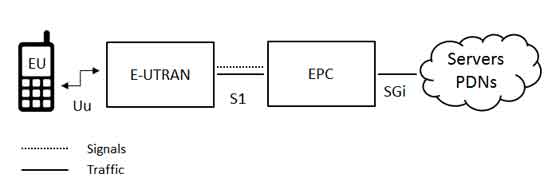
The internal architecture of the user equipment for LTE is identical to the one used by UMTS and GSM which is actually a Mobile Equipment (ME). The mobile equipment comprised of the following important modules:
A USIM stores user-specific data very similar to 3G SIM card. This keeps information about the user’s phone number, home network identity and security keys etc.
The architecture of evolved UMTS Terrestrial Radio Access Network (E-UTRAN) has been illustrated below.
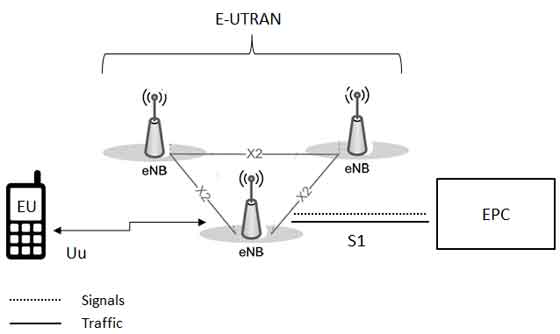
The E-UTRAN handles the radio communications between the mobile and the evolved packet core and just has one component, the evolved base stations, called eNodeB or eNB. Each eNB is a base station that controls the mobiles in one or more cells. The base station that is communicating with a mobile is known as its serving eNB.
LTE Mobile communicates with just one base station and one cell at a time and there are following two main functions supported by eNB:
Each eBN connects with the EPC by means of the S1 interface and it can also be connected to nearby base stations by the X2 interface, which is mainly used for signalling and packet forwarding during handover.
A home eNB (HeNB) is a base station that has been purchased by a user to provide femtocell coverage within the home. A home eNB belongs to a closed subscriber group (CSG) and can only be accessed by mobiles with a USIM that also belongs to the closed subscriber group.
The architecture of Evolved Packet Core (EPC) has been illustrated below. There are few more components which have not been shown in the diagram to keep it simple. These components are like the Earthquake and Tsunami Warning System (ETWS), the Equipment Identity Register (EIR) and Policy Control and Charging Rules Function (PCRF).
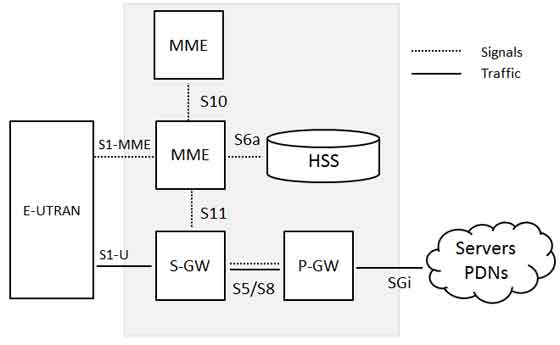
Below is a brief description of each of the components shown in the above architecture:
The interface between the serving and PDN gateways is known as S5/S8. This has two slightly different implementations, namely S5 if the two devices are in the same network, and S8 if they are in different networks.
Following diagram shows the functional split between the E-UTRAN and the EPC for an LTE network:
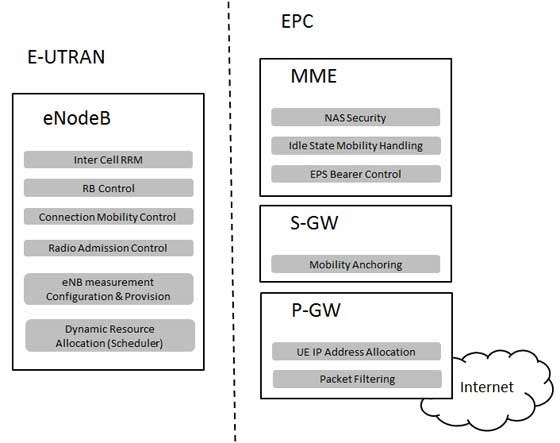
Following table compares various important Network Elements & Signaling protocols used in 2G/3G abd LTE.
| 2G/3G | LTE |
|---|---|
| GERAN and UTRAN | E-UTRAN |
| SGSN/PDSN-FA | S-GW |
| GGSN/PDSN-HA | PDN-GW |
| HLR/AAA | HSS |
| VLR | MME |
| SS7-MAP/ANSI-41/RADIUS | Diameter |
| DiameterGTPc-v0 and v1 | GTPc-v2 |
| MIP | PMIP |
Source: LTE Network Architecture
Jovan Stosic
In order to obtain the ARFCN/UARFCN/EARFCN, you will need to enter “Field Test Mode” in your phone. This varies greatly from phone to phone. In general, all involve “calling” certain numbers to bring up the hidden options
Some common ones are:
Samsung (Android): *#*#197328640#*#* or *#0011#
iPhone (all): *3001#12345#*
HTC (Android): *#*#7262626#*#*
Jovan Stosic
A Home eNodeB, or HeNB, is the 3GPP’s term for an LTE femtocell or Small Cell.
An eNodeB is an element of an LTE Radio Access Network, or E-UTRAN. A HeNB performs the same function of an eNodeB, but is optimized for deployment for smaller coverage than macro eNodeB, such as indoor premises and public hotspots.
Home Node B is 3G (UMTS) counterpart of the HeNB.
Source: Home eNodeB – Wikipedia