Arduino – Setting up an Arduino on a breadboard
 Jovan Stosic
Jovan Stosic
Jovan Stosic
Jovan Stosic
Jovan Stosic
Jovan Stosic
Jovan Stosic
The high-level network architecture of LTE is comprised of following three main components:
The evolved packet core communicates with packet data networks in the outside world such as the internet, private corporate networks or the IP multimedia subsystem. The interfaces between the different parts of the system are denoted Uu, S1 and SGi as shown below:
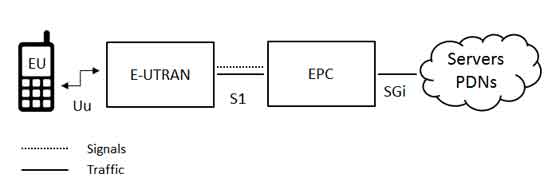
The internal architecture of the user equipment for LTE is identical to the one used by UMTS and GSM which is actually a Mobile Equipment (ME). The mobile equipment comprised of the following important modules:
A USIM stores user-specific data very similar to 3G SIM card. This keeps information about the user’s phone number, home network identity and security keys etc.
The architecture of evolved UMTS Terrestrial Radio Access Network (E-UTRAN) has been illustrated below.
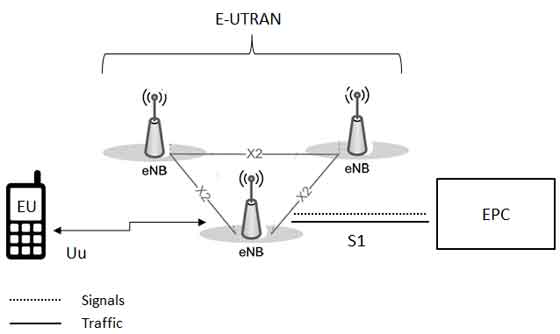
The E-UTRAN handles the radio communications between the mobile and the evolved packet core and just has one component, the evolved base stations, called eNodeB or eNB. Each eNB is a base station that controls the mobiles in one or more cells. The base station that is communicating with a mobile is known as its serving eNB.
LTE Mobile communicates with just one base station and one cell at a time and there are following two main functions supported by eNB:
Each eBN connects with the EPC by means of the S1 interface and it can also be connected to nearby base stations by the X2 interface, which is mainly used for signalling and packet forwarding during handover.
A home eNB (HeNB) is a base station that has been purchased by a user to provide femtocell coverage within the home. A home eNB belongs to a closed subscriber group (CSG) and can only be accessed by mobiles with a USIM that also belongs to the closed subscriber group.
The architecture of Evolved Packet Core (EPC) has been illustrated below. There are few more components which have not been shown in the diagram to keep it simple. These components are like the Earthquake and Tsunami Warning System (ETWS), the Equipment Identity Register (EIR) and Policy Control and Charging Rules Function (PCRF).
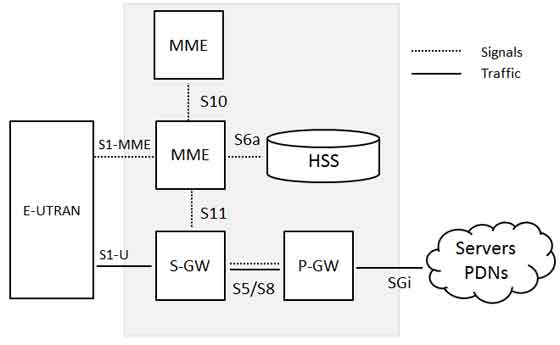
Below is a brief description of each of the components shown in the above architecture:
The interface between the serving and PDN gateways is known as S5/S8. This has two slightly different implementations, namely S5 if the two devices are in the same network, and S8 if they are in different networks.
Following diagram shows the functional split between the E-UTRAN and the EPC for an LTE network:
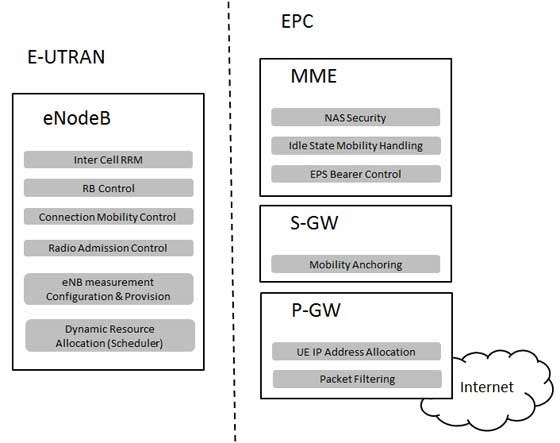
Following table compares various important Network Elements & Signaling protocols used in 2G/3G abd LTE.
| 2G/3G | LTE |
|---|---|
| GERAN and UTRAN | E-UTRAN |
| SGSN/PDSN-FA | S-GW |
| GGSN/PDSN-HA | PDN-GW |
| HLR/AAA | HSS |
| VLR | MME |
| SS7-MAP/ANSI-41/RADIUS | Diameter |
| DiameterGTPc-v0 and v1 | GTPc-v2 |
| MIP | PMIP |
Source: LTE Network Architecture
Jovan Stosic
In order to obtain the ARFCN/UARFCN/EARFCN, you will need to enter “Field Test Mode” in your phone. This varies greatly from phone to phone. In general, all involve “calling” certain numbers to bring up the hidden options
Some common ones are:
Samsung (Android): *#*#197328640#*#* or *#0011#
iPhone (all): *3001#12345#*
HTC (Android): *#*#7262626#*#*
Jovan Stosic
A Home eNodeB, or HeNB, is the 3GPP’s term for an LTE femtocell or Small Cell.
An eNodeB is an element of an LTE Radio Access Network, or E-UTRAN. A HeNB performs the same function of an eNodeB, but is optimized for deployment for smaller coverage than macro eNodeB, such as indoor premises and public hotspots.
Home Node B is 3G (UMTS) counterpart of the HeNB.
Source: Home eNodeB – Wikipedia
Jovan Stosic
The access stratum (AS) is a functional layer in the UMTS and LTE wireless telecom protocol stacks between radio network and user equipment.[1] While the definition of the access stratum is very different between UMTS and LTE, in both cases the access stratum is responsible for transporting data over the wireless connection and managing radio resources. The radio network is also called access network.
Source: Access stratum – Wikipedia
Jovan Stosic
Non-access stratum (NAS) is a functional layer in the UMTS and LTE wireless telecom protocol stacks between the core network and user equipment.[1] This layer is used to manage the establishment of communication sessions and for maintaining continuous communications with the user equipment as it moves. The NAS is defined in contrast to the Access Stratum which is responsible for carrying information over the wireless portion of the network. A further description of NAS is that it is a protocol for messages passed between the User Equipment, also known as mobiles, and Core Nodes (e.g. Mobile Switching Center, Serving GPRS Support Node, or Mobility Management Entity) that is passed transparently through the radio network. Examples of NAS messages include Update or Attach messages, Authentication Messages, Service Requests and so forth. Once the User Equipment (UE) establishes a radio connection, the UE uses the radio connection to communicate with the core nodes to coordinate service. The distinction is that the Access Stratum is for dialogue explicitly between the mobile equipment and the radio network and the NAS is for dialogue between the mobile equipment and core network nodes. For LTE, the Technical Standard for NAS is 3GPP TS 24.301.
+- – – – – -+ +- – – – – – -+
| HTTP | | Application |
+- – – – – -+ +- – – – – – -+
| TCP | | Transport |
+- – – – – -+ +- – – – – – -+
| IP | | Internet |
+- – – – – -+ +- – – – – – -+
| NAS | | Network |
+- – – – – -+ +- – – – – – -+
| AS | | Link |
+- – – – – -+ +- – – – – – -+
| Channels | | Physical |
+- – – – – -+ +- – – – – – -+
Source: Non-access stratum – Wikipedia
Jovan Stosic
A GSM Cell ID (CID) is a generally unique number used to identify each base transceiver station (BTS) or sector of a BTS within a location area code (LAC) if not within a GSM network.
In some cases the first or last digit of CID represents cells’ Sector ID:
value 0 is used for omnidirectional antenna,
values 1, 2, 3 are used to identify sectors of trisector or bisector antennas.
In UMTS, there is a distinction between Cell ID (CID) and UTRAN Cell ID (also called LCID). The UTRAN Cell ID (LCID) is a concatenation of the RNC-ID (12 bits, ID of the Radio Network Controller) and Cell ID (16 bits, unique ID of the Cell). CID is just the Cell ID. The concatenation of both will still be unique but can be confusing in some cellid databases as some store the CID and other store LCID. It makes sense to record them separately as the RNC ID is the same for many cells, the unique element is the CID.
A valid CID ranges from 0 to 65535 (216 − 1) on GSM and CDMA networks and from 0 to 268435455 (228 − 1) on UMTS and LTE networks.
Source: Cell ID – Wikipedia
Jovan Stosic
Source: LTE frequency band
Jovan Stosic
Jovan Stosic
HSPA+ vs LTE: Which one is better?
Source: HSPA+ vs LTE: Which one is better? | AndroidAuthority
Jovan Stosic
Supervisory control and data acquisition (SCADA) is a control system architecture that uses computers, networked data communications and graphical user interfaces for high-level process supervisory management, but uses other peripheral devices such as programmable logic controllers and discrete PID controllers to interface to the process plant or machinery. The operator interfaces which enable monitoring and the issuing of process commands, such as controller set point changes, are handled through the SCADA supervisory computer system. However, the real-time control logic or controller calculations are performed by networked modules which connect to the field sensors and actuators.
The SCADA concept was developed as a universal means of remote access to a variety of local control modules, which could be from different manufacturers allowing access through standard automation protocols. In practice, large SCADA systems have grown to become very similar to distributed control systems in function, but using multiple means of interfacing with the plant. They can control large-scale processes that can include multiple sites, and work over large distances.[1] It is one of the most commonly-used types of industrial control systems, however there are concerns about SCADA systems being vulnerable to cyberwarfare/cyberterrorism attacks.[2]
Source: SCADA – Wikipedia