Imax B6AC charger/balancer pinouts
 Jovan Stosic
Jovan Stosic
Jovan Stosic
Jovan Stosic
Jovan Stosic
Jovan Stosic
Jovan Stosic
Jovan Stosic
Jovan Stosic
Jovan Stosic
Jovan Stosic
Jovan Stosic
Jovan Stosic
Jovan Stosic
Jovan Stosic
After you have setup your camera make sure you can view Monitor streams, if not check some of the common causes:
Check Apache cgi module is enabled.
Check Apache /etc/apache2/conf-enabled/zoneminder.conf ScriptAlias matches PATH_ZMS.
ScriptAlias /zm/cgi-bin /usr/lib/zoneminder/cgi-bin
From console go to
Options->Pathand make sure PATH_ZMS is set to /zm/cgi-bin/nph-zms.
Jovan Stosic
Democritus (/dɪˈmɒkrɪtəs/; Greek: Δημόκριτος, Dēmókritos, meaning “chosen of the people”; c.460 — c.370 BC) was an Ancient Greek pre-Socratic philosopher primarily remembered today for his formulation of an atomic theory of the universe.
Democritus was born in Abdera, Thrace, around 460 BC, although there are disagreements about the exact year. His exact contributions are difficult to disentangle from those of his mentor Leucippus, as they are often mentioned together in texts. Their speculation on atoms, taken from Leucippus, bears a passing and partial resemblance to the 19th-century understanding of atomic structure that has led some to regard Democritus as more of a scientist than other Greek philosophers; however, their ideas rested on very different bases. Largely ignored in ancient Athens, Democritus is said to have been disliked so much by Plato that the latter wished all of his books burned. He was nevertheless well known to his fellow northern-born philosopher Aristotle. Many consider Democritus to be the “father of modern science”. None of his writings have survived; only fragments are known from his vast body of work.
href=”https://en.wikipedia.org/wiki/Democritus”>Democritus – Wikipedia
Jovan Stosic
I had two ownclouds 9.1.8. I shutdown the one owncloud server, resulting in terible reduction in speed of the other owncloud server. Deleting from the web interface was not possible, too.
Deleting the rows in the database of oc_share_external worked, external shares are now gone and the performance of the active owncloud normalized.
Jovan Stosic
You’re using manually installed PHP packages that don’t stem from the official repositories. Anything could happen in that case and I suggest that you report the issue to their maintainer.
The immediate solution is to revert to the in-repository packages with:
sudo apt install php5=5.5.9+dfsg-1ubuntu4.20 php5-xdebug=2.2.3-2build1If you have other packages depending on that php5version you’ll need to install their respective in-repository versions in the same fashion.
dpkg -iHow do I install different (upgrade or downgrade) PHP version in still supported Ubuntu release? has an excellent answer that lists such a PPA.
You probably want to remove the current PHP 5 installation since the PPA packages have different names to allow different independent PHP installations:
sudo apt remove php5 php5-xdebugAdd the PPA, upgrade your packages and install the new PHP and xdebug packages:
sudo add-apt-repository ppa:ondrej/phpsudo apt updatesudo apt upgradesudo apt install php5.6 php-xdebug
As in the previous solution you’ll need to remove packages that depend on php5 (happens automatically with apt remove php5) and later re-add their php5.6counterparts
The error is as a result of the fact you are loading an xdebug which was compiled with a php versiondifferent from the one installed on your system
And you should look for one that was compiled with the same php version on your system.
Look at this article here for further help.
https://askubuntu.com/questions/856996/cant-install-xdebug-depends-phpapi-20121212-ubuntu-14-04
Jovan Stosic
Overall, the Lagrangian has units of energy, but no single expression for all physical systems. Any function which generates the correct equations of motion, in agreement with physical laws, can be taken as a Lagrangian. It is nevertheless possible to construct general expressions for large classes of applications. The non-relativistic Lagrangian for a system of particles can be defined by[9]
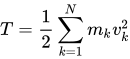
where
is the total kinetic energy of the system, equalling the sum Σ of the kinetic energies of the particles,[10] and V is the potential energy of the system.
Kinetic energy is the energy of the system’s motion, and vk2 = vk · vk is the magnitude squared of velocity, equivalent to the dot product of the velocity with itself. The kinetic energy is a function only of the velocities vk, not the positions rk nor time t, so T = T(v1, v2, …).
The potential energy of the system reflects the energy of interaction between the particles, i.e. how much energy any one particle will have due to all the others and other external influences. For conservative forces (e.g. Newtonian gravity), it is a function of the position vectors of the particles only, so V = V(r1, r2, …). For those non-conservative forces which can be derived from an appropriate potential (e.g. electromagnetic potential), the velocities will appear also, V = V(r1, r2, …, v1, v2, …). If there is some external field or external driving force changing with time, the potential will change with time, so most generally V = V(r1, r2, …, v1, v2, …, t).
https://en.wikipedia.org/wiki/Lagrangian_mechanics
Jovan Stosic
https://trends.google.com/trends/explore?q=ownCloud,Nextcloud,Seafile,Pydio