Bryce Seligman DeWitt (January 8, 1923 – September 23, 2004) was an American theoretical physicist who studied gravity and field theories.
href=”https://en.wikipedia.org/wiki/Bryce_DeWitt”>Bryce DeWitt – Wikipedia
Bryce DeWitt
 Jovan Stosic
Jovan Stosic
Jovan Stosic
Bryce Seligman DeWitt (January 8, 1923 – September 23, 2004) was an American theoretical physicist who studied gravity and field theories.
href=”https://en.wikipedia.org/wiki/Bryce_DeWitt”>Bryce DeWitt – Wikipedia
Jovan Stosic
Anaximander (/æˌnæksɪˈmændər/; Greek: Ἀναξίμανδρος Anaximandros; c. 610 – c. 546 BC) was a pre-Socratic Greek philosopher who lived in Miletus,[4] a city of Ionia (in modern-day Turkey). He belonged to the Milesian school and learned the teachings of his master Thales. He succeeded Thales and became the second master of that school where he counted Anaximenes and, arguably, Pythagoras amongst his pupils.[5]
Little of his life and work is known today. According to available historical documents, he is the first philosopher known to have written down his studies,[6] although only one fragment of his work remains. Fragmentary testimonies found in documents after his death provide a portrait of the man.
He was an early proponent of science and tried to observe and explain different aspects of the universe, with a particular interest in its origins, claiming that nature is ruled by laws, just like human societies, and anything that disturbs the balance of nature does not last long.[7] Like many thinkers of his time, Anaximander’s philosophy included contributions to many disciplines. In astronomy, he attempted to describe the mechanics of celestial bodies in relation to the Earth. In physics, his postulation that the indefinite (or apeiron) was the source of all things led Greek philosophy to a new level of conceptual abstraction. His knowledge of geometry allowed him to introduce the gnomon in Greece. He created a map of the world that contributed greatly to the advancement of geography. He was also involved in the politics of Miletus and was sent as a leader to one of its colonies.
href=”https://en.wikipedia.org/wiki/Anaximander”>Anaximander – Wikipedia
Jovan Stosic
Democritus (/dɪˈmɒkrɪtəs/; Greek: Δημόκριτος, Dēmókritos, meaning “chosen of the people”; c.460 — c.370 BC) was an Ancient Greek pre-Socratic philosopher primarily remembered today for his formulation of an atomic theory of the universe.
Democritus was born in Abdera, Thrace, around 460 BC, although there are disagreements about the exact year. His exact contributions are difficult to disentangle from those of his mentor Leucippus, as they are often mentioned together in texts. Their speculation on atoms, taken from Leucippus, bears a passing and partial resemblance to the 19th-century understanding of atomic structure that has led some to regard Democritus as more of a scientist than other Greek philosophers; however, their ideas rested on very different bases. Largely ignored in ancient Athens, Democritus is said to have been disliked so much by Plato that the latter wished all of his books burned. He was nevertheless well known to his fellow northern-born philosopher Aristotle. Many consider Democritus to be the “father of modern science”. None of his writings have survived; only fragments are known from his vast body of work.
href=”https://en.wikipedia.org/wiki/Democritus”>Democritus – Wikipedia
Jovan Stosic
Etiology (/iːtiˈɒlədʒi/; alternatively aetiology or ætiology) is the study of causation, or origination. The word is derived from the Greek αἰτιολογία, aitiología, “giving a reason for” (αἰτία, aitía, “cause”; and -λογία, -logía). More completely, etiology is the study of the causes, origins, or reasons behind the way that things are, or the way they function, or it can refer to the causes themselves. The word is commonly used in medicine, (where it is a branch of medicine studying causes of diease) and in philosophy, but also in physics, psychology, government, geography, spatial analysis, theology, and biology, in reference to the causes or origins of various phenomena.
In the past, when many physical phenomena were not well understood or when histories were not recorded, myths often arose to provide etiologies. Thus, an etiological myth, or origin myth, is a myth that has arisen, been told over time or written to explain the origins of various social or natural phenomena. For example, Virgil’s Aenead is a national myth written to explain and glorify the origins of the Roman Empire. In theology, many religions have creation myths explaining the origins of the world or its relationship to believers.
href=”https://en.wikipedia.org/wiki/Etiology”>Etiology – Wikipedia
Jovan Stosic
Carlo Rovelli (born 3 May 1956) is an Italian theoretical physicist and writer who has worked in Italy, the United States and since 2000, in France. His work is mainly in the field of quantum gravity, where he is among the founders of the loop quantum gravity theory. He has also worked in the history and philosophy of science. He collaborates with several Italian newspapers, in particular the cultural supplements of the Corriere della Sera, Il Sole 24 Ore and La Repubblica. His popular science book Seven Brief Lessons on Physics has been translated in 41 languages and has sold over a million copies worldwide.
Source: Carlo Rovelli – Wikipedia
Jovan Stosic
I had two ownclouds 9.1.8. I shutdown the one owncloud server, resulting in terible reduction in speed of the other owncloud server. Deleting from the web interface was not possible, too.
Deleting the rows in the database of oc_share_external worked, external shares are now gone and the performance of the active owncloud normalized.
Jovan Stosic
You’re using manually installed PHP packages that don’t stem from the official repositories. Anything could happen in that case and I suggest that you report the issue to their maintainer.
The immediate solution is to revert to the in-repository packages with:
sudo apt install php5=5.5.9+dfsg-1ubuntu4.20 php5-xdebug=2.2.3-2build1If you have other packages depending on that php5version you’ll need to install their respective in-repository versions in the same fashion.
dpkg -iHow do I install different (upgrade or downgrade) PHP version in still supported Ubuntu release? has an excellent answer that lists such a PPA.
You probably want to remove the current PHP 5 installation since the PPA packages have different names to allow different independent PHP installations:
sudo apt remove php5 php5-xdebugAdd the PPA, upgrade your packages and install the new PHP and xdebug packages:
sudo add-apt-repository ppa:ondrej/phpsudo apt updatesudo apt upgradesudo apt install php5.6 php-xdebug
As in the previous solution you’ll need to remove packages that depend on php5 (happens automatically with apt remove php5) and later re-add their php5.6counterparts
The error is as a result of the fact you are loading an xdebug which was compiled with a php versiondifferent from the one installed on your system
And you should look for one that was compiled with the same php version on your system.
Look at this article here for further help.
https://askubuntu.com/questions/856996/cant-install-xdebug-depends-phpapi-20121212-ubuntu-14-04
Jovan Stosic
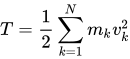
Overall, the Lagrangian has units of energy, but no single expression for all physical systems. Any function which generates the correct equations of motion, in agreement with physical laws, can be taken as a Lagrangian. It is nevertheless possible to construct general expressions for large classes of applications. The non-relativistic Lagrangian for a system of particles can be defined by[9]
where
is the total kinetic energy of the system, equalling the sum Σ of the kinetic energies of the particles,[10] and V is the potential energy of the system.
Kinetic energy is the energy of the system’s motion, and vk2 = vk · vk is the magnitude squared of velocity, equivalent to the dot product of the velocity with itself. The kinetic energy is a function only of the velocities vk, not the positions rk nor time t, so T = T(v1, v2, …).
The potential energy of the system reflects the energy of interaction between the particles, i.e. how much energy any one particle will have due to all the others and other external influences. For conservative forces (e.g. Newtonian gravity), it is a function of the position vectors of the particles only, so V = V(r1, r2, …). For those non-conservative forces which can be derived from an appropriate potential (e.g. electromagnetic potential), the velocities will appear also, V = V(r1, r2, …, v1, v2, …). If there is some external field or external driving force changing with time, the potential will change with time, so most generally V = V(r1, r2, …, v1, v2, …, t).
https://en.wikipedia.org/wiki/Lagrangian_mechanics
Jovan Stosic
In quantum mechanics, a Hamiltonian is an operator corresponding to the total energy of the system in most of the cases. It is usually denoted by H, also Ȟ or Ĥ. Its spectrum is the set of possible outcomes when one measures the total energy of a system. Because of its close relation to the time-evolution of a system, it is of fundamental importance in most formulations of quantum theory.
The Hamiltonian is named after William Rowan Hamilton, who also created a revolutionary reformation of Newtonian mechanics, now called Hamiltonian mechanics, that is important in quantum physics.
https://en.wikipedia.org/wiki/Hamiltonian_(quantum_mechanics)
Jovan Stosic
In theoretical physics, the problem of time is a conceptual conflict between general relativity and quantum mechanics in that quantum mechanics regards the flow of time as universal and absolute, whereas general relativity regards the flow of time as malleable and relative.[1] This problem raises the question of what time really is in a physical sense and whether it is truly a real, distinct phenomenon. It also involves the related question of why time seems to flow in a single direction, despite the fact that no known physical laws seem to require a single direction.
https://en.wikipedia.org/wiki/Problem_of_time
Jovan Stosic
The Wheeler–DeWitt equation[1] is a field equation. It is part of a theory that attempts to combine mathematically the ideas of quantum mechanics and general relativity, a step towards a theory of quantum gravity. In this approach, time plays a role different from what it does in non-relativistic quantum mechanics, leading to the so-called ‘problem of time’.[2] More specifically, the equation describes the quantum version of the Hamiltonian constraint using metric variables. Its commutation relations with the diffeomorphism constraints generate the Bergman-Komar “group” (which is the diffeomorphism group on-shell.
https://en.wikipedia.org/wiki/Wheeler%E2%80%93DeWitt_equation
Jovan Stosic
https://trends.google.com/trends/explore?q=ownCloud,Nextcloud,Seafile,Pydio